


Bigger is not always better: smaller leaves optimize light use in soybeans
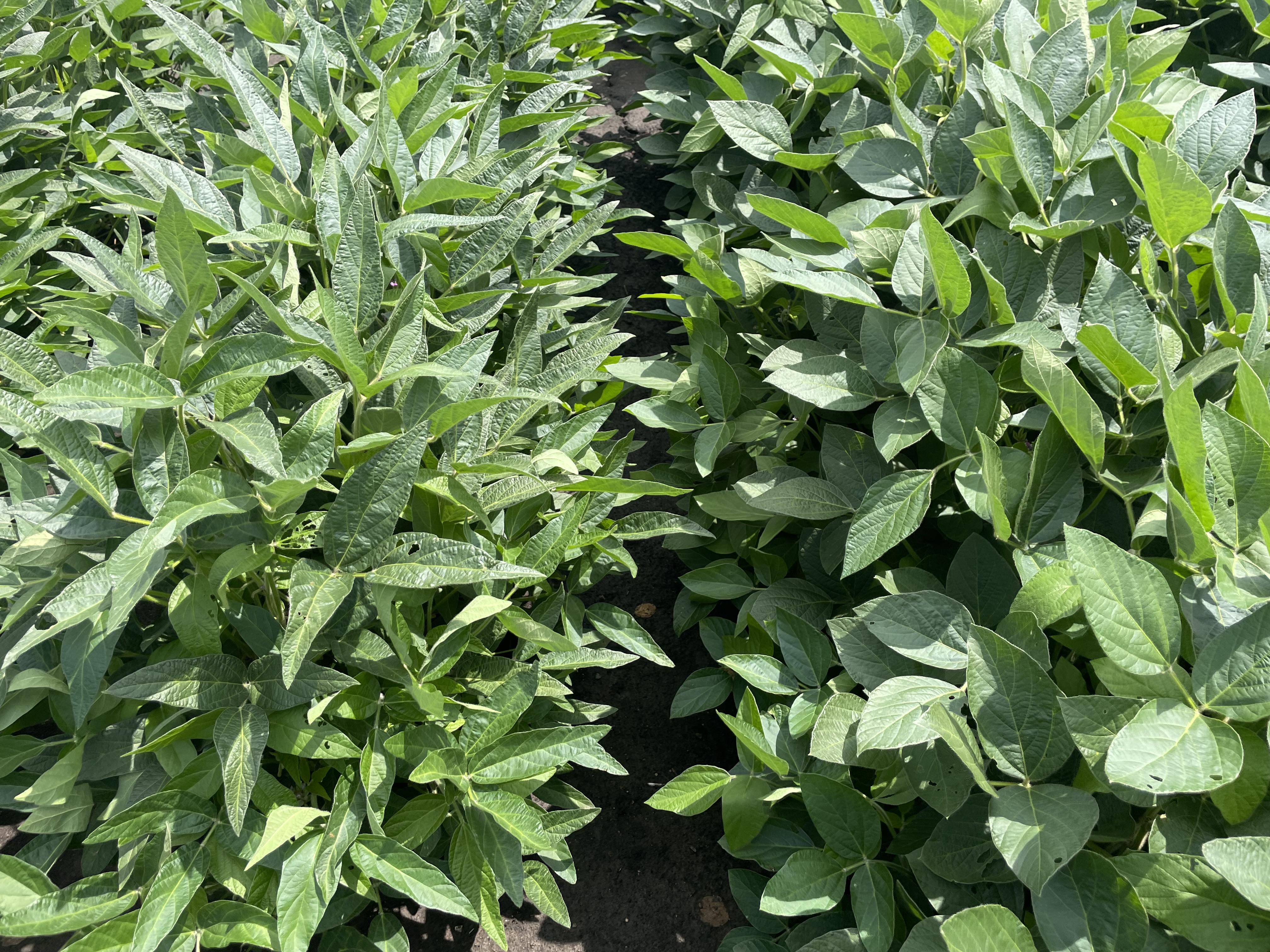
URBANA, Ill. – In efforts to better understand how soybean plants capture and use light, researchers at the University of Illinois Urbana-Champaign investigated how leaf size and shape affect light distribution within the crop canopy. Using controlled genetic approaches, the team altered soybean leaf shape and found that narrower leaves can improve how efficiently plants use available light.
The study, published in the journal Plant Physiology, was led by RIPE Director and Charles Adlai Ewing Chair of Crop Physiology Lisa Ainsworth.
“By simply changing the shape of the leaf from broad to narrow through a single gene, we reduced the total leaf area in our soybean plants by 13% without any loss in yield.” said Bishal Tamang, a postdoctoral researcher in the Ainsworth group and the lead author of the publication. “This means the plants are doing more with less- they're essentially becoming more efficient at converting sunlight into seed.”
Soybeans are one of the most important crops in the world and are a major source of protein, oil, and animal feed. Soybean plants grow dense canopies with several layers of leaves. As the plants grow, the upper layers with sun-exposed leaves block sunlight that could reach the lower layers of shaded leaves. There is natural variation in soybean leaf area and size with some being long and skinny and others being large and round. But, modern soybean varieties tend to spend excess energy developing large leaves that create dense canopies when they could be funneling that energy into growing soybeans instead.
“You can imagine that when the leaves are big and round, the top part of the plant covers the whole canopy and the bottom part is often starved of light,” Tamang said. “But if we make the leaves narrow, we open up the vertical profile. Meaning that we are improving the light use efficiency of the plant.”
This work was conducted as part of the RIPE project, an international research collaboration focused on improving how food crops use sunlight. The research was supported by Gates Agricultural Innovations (Gates Ag One) and contributes to RIPE’s Optimizing Canopies objective, which examines how light is distributed within crop canopies.
The narrow-leaf trait in soybean plants is controlled by a singular gene–GmJAG1. Using controlled breeding strategies, the researchers altered the gene expression of GmJAG1 to develop 204 different soybean plant lines. These displayed a wide range of leaf shapes, while still having nearly identical genetic codes.
They compared the productivity of the plants (number of soybeans and number of soybeans per pod) with differences in leaf area index (area of leaves per unit area of land) to determine if soybean canopies with narrow leaves had better light use efficiency. The results showed that for narrow leaf lines, canopy leaf area could be reduced by 13% without a negative impact on soybean yield. The reduction in canopy leaf area indicates better light penetration through the plant canopy. Soybeans plants with narrow leaves also produced a greater proportion of soybean pods with 4 beans.
These findings challenge traditional soybean breeding strategies that have resulted in suboptimal light penetration into the plant canopy and suggest that the single-gene control of leaf shape through GmJAG1 offers a good approach to create resource-use efficient soybean lines.
“In the RIPE project, we are testing different transgenic strategies to improve the efficiency of photosynthesis. We have used computational models to show that many of those strategies will be more effective in a high light environment,” Ainsworth said. “Our soybean lines with lower leaf area provide an improved canopy architecture that we think will increase the probability of successfully realizing greater photosynthetic efficiency with our transgenic approaches.”
In the future, these changes in canopy architecture can be coupled with other strategies to increase light, water, and nutrient use efficiencies to increase overall soybean production.
“In addition to improving canopy photosynthesis and yield, we also want to improve the water use efficiency of our crops to face a warmer world with greater evaporative demand,” said Ainsworth.
By: Brittany Prempin, RIPE project
Publication information
Bishal G Tamang, Gregory Bernard, Carl J Bernacchi, Brian W Diers, Elizabeth A Ainsworth, Bigger is not always better: Optimizing leaf area index with narrow leaf shape in soybean, Plant Physiology, (2025). https://doi.org/10.1093/plphys/kiaf663