


RIPE at SEB2026
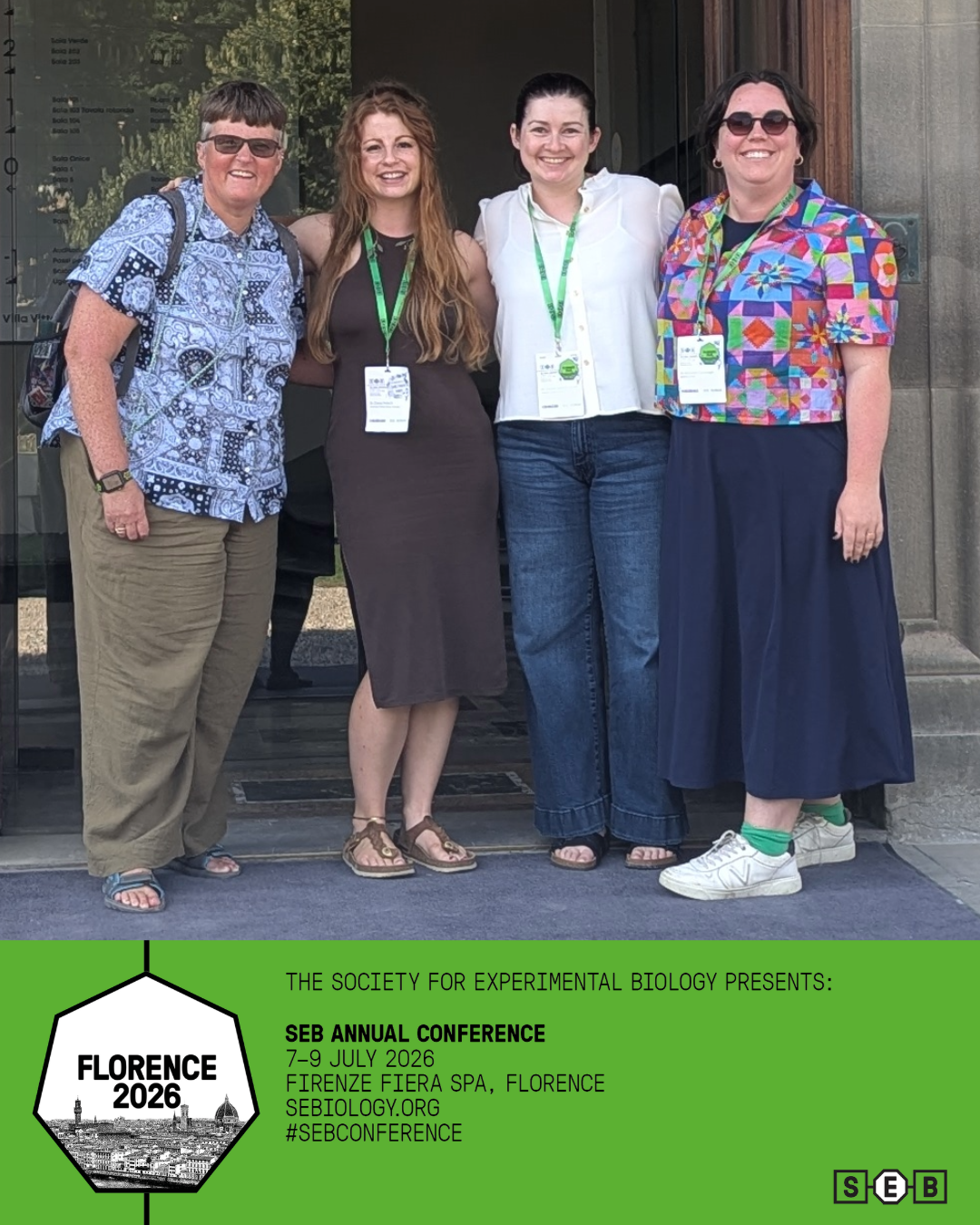
Last week, RIPE researchers Elena Pelech, Coralie Salesse-Smith, and Amanda Cavanagh attended the 2026 Society for Environmental Biology (SEB) Annual Conference in Florence, Italy. Elena and Coralie both presented research talks at the "Insights into multi-scale Plant Environmental Physiology: PEPG at 50” session. Amanda was an organizer for the “PEPG 50th Celebration” session. Here are their reflections:
Elena
My talk titled "Manipulating the stomatal blue light response to improve crop water-use efficiency" represented my current research on transgenic soybean that has knocked down the BLUS1 gene, a protein kinase involved in the blue light response pathway that induces stomatal opening. I included successful results from greenhouse experiments and discussed translation in the field, highlighting measurement plans for this summer across two field experiments. This work is particularly important because by removing the blue light response, increasing water-use efficiency may be achieved without affecting photosynthetic rate.
My favourite moment of the conference was reconnecting with past colleagues and networking with new people! This was my first SEB conference, and the community was very positive and supportive.
Coralie:
In my talk "Enhancing CO2 diffusion and fixation to improve crop productivity", I presented RIPE work from my postdoc at UIUC that addresses the need for increased crop productivity and climate resilience to feed a growing population. Here we engineered soybeans to simultaneously increase Rubisco content and mesophyll conductance (gm), in order to improve photosynthetic efficiency. Stacking these two photosynthetic traits resulted in significantly higher CO2 assimilation rates and greater field productivity than modifying either trait alone. These findings demonstrate that combining multiple photosynthetic efficiency improvements is a viable strategy for enhancing future food production and crop resilience.
My favourite moments were attending the Plenary Lecture by Prof. Julian Hibberd and the President’s Medallist talk by Dr. Lorna McAusland, both of which highlighted cutting-edge plant science. The conference structure provided great networking opportunities, allowing me to connect with potential collaborators and scout prospective lab members. It was equally rewarding to catch up in person with RIPE colleagues. A key takeaway is that the SEB is an invaluable resource, especially for early-career researchers, and I will strongly encourage my lab members and colleagues at UBC to join.
Amanda
Organising a session is a great way to be involved in the SEB, and to network with your international colleagues. My session focussed on charting the next 50 years of our special interest group PEPG: Plant Environmental Physiology Group, which many people in RIPE have been affiliated with over the years. The next SEB meeting is in Glasgow in 2027, and all members can propose a session here. If anybody on RIPE is keen to get involved with the PEPG, they should reach out.
One favourite moment was watching RIPE alum Lorna McAusland (now a BBSRC Fellow at Nottingham) win the President's medal, which is awarded annually to an exceptional early career researcher. Lorna did her PhD in Tracy Lawson's lab at the University of Essex before working briefly on RIPE 1.0.
My favourite moments from any meeting are always the moments of connection, like a conversation with a colleague that happens by chance, which spark new ideas or collaborations. It's just not something that can be replicated online. But the best part of this conference was getting to listen to so many fantastic talks from researchers who are passionate about understanding plant resilience in a changing climate, which felt more urgent in an unairconditioned room in Florence during a heatwave.