


Reflections on the 47th New Phytologist Symposium on Extreme Heat
By Elizabete Carmo-Silva
A few weeks ago, I and 149 other scientists gathered in Cordoda, Spain to discuss our research on how plants adapt to extreme heat at The 47th New Phytologist Symposium on Extreme Heat. Ironically, Cordoba was also experiencing a heatwave, making our research feel more salient than ever. This conference was one of the best events I attended recently. The combination of diversity in expertise with passion for studying plant adaptation to extreme heat yielded a fruitful meeting rich in nuanced discussion and co-designing holistic solutions.
The symposium focused on identifying solutions for the challenges posed by extreme heat conditions on plants in both natural and urban ecosystems as well as agricultural systems. The 150 participants from 29 different countries included plant biologists, ecologists, computational scientists, and data scientists who focus on this great challenge from either a plant, insect (pollinators), or microbiome perspectives. By sharing findings and experiences from a multitude of perspectives and disciplines, we were all blown away by the scale of the challenge for the future of nature and of our food systems, which will directly impact humankind.
The whole week resonated deeply with the work we have been doing within RIPE's Improving Rubisco objective. In RIPE, we focus on increasing plant resilience and thermotolerance from a genetic engineering perspective. It was enlightening to hear about others working towards the same goal using different approaches.
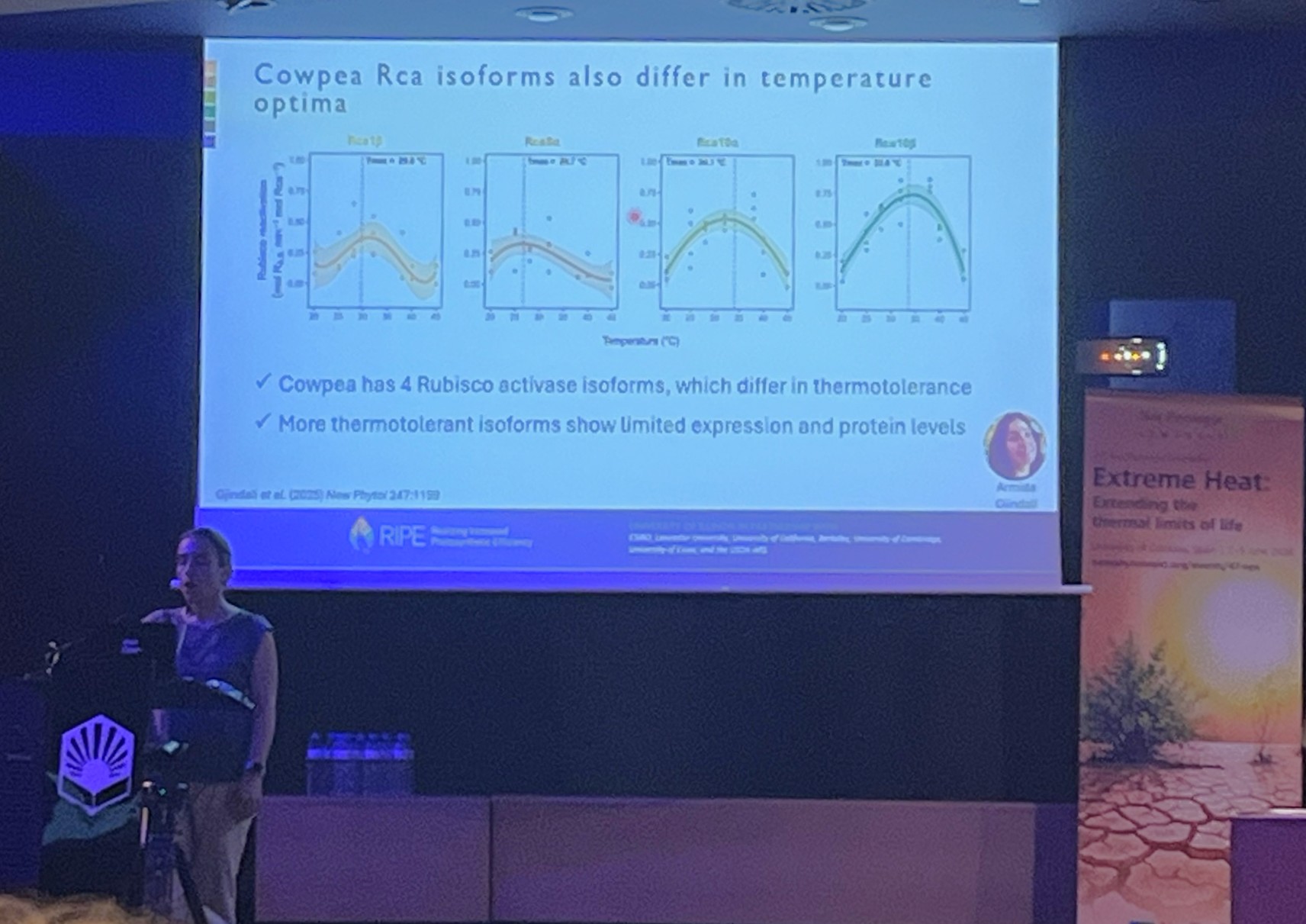
I was honoured to contribute a talk on the research we are doing at Lancaster to develop crop plants that can better cope with heatwaves, and to contribute to several breakout sessions and the final reflections panel. In my talk titled "Achieving sustainable crop productivity in a hotter world", I discussed how Rubisco deactivation is a key limitation of crop productivity when plants warm up above their optimum temperature. Rubisco is activated by Rubisco activase which is sensitive to hot temperatures. Our research in wheat and more recently in cowpea has highlighted variants of Rubisco activase that are more thermotolerant and hold promise to enhance the resilience of photosynthesis to heatwaves.
I was also glad to attend the conference alongside fellow RIPE researcher Tracy Lawson, who brings in the critical knowledge of how to control water loss through stomata – a key aspect in plant resilience to hot environments. Discussions with Tracy about the interplay of heat and drought highlighted the importance of large interdisciplinary research collaborations like RIPE are necessary to enable holistic development of robust plants.
Tracy summarized her experience at the meeting stating:
"I greatly enjoyed chairing the session entitled ‘Designing food systems and landscape for a hotter world’ in which Elizabete was the invited speaker, which covered a range of topics from genetic interventions, natural variation in resilience to novelty cropping systems to avoid drought and heat stress. Elizabete and I also lead breakout sessions discussing solutions to the challenges of extreme heat. These were excellent opportunities to bring together ideas from experts in different fields, as well as engaging all participants in the process. In these sessions we started developing some potential solutions to tackle how we might grow crops in a future warmer world. A novel aspect of the conference was that the findings from all of the various breakout discussions were synthesised in the closing ceremony to collate all the innovative ideas to produce a roadmap to formulate the next steps in tackling extreme heat."
The symposium left me with this key takeaway: there is no solution that fits all systems. Despite this, we certainly learnt from the different systems to inform new comprehensive approaches towards plant resilience under extreme heat. For example, I learned of nature-based solutions from plants adapted to survive in extreme environments such as drylands, deserts or tropical forests. We can pull ideas and strategies from these natural mechanisms to inform new strategies for making more resilient agricultural crops.
I left this conference with a feeling of hope. The hope for me comes from the willingness of the participants to work collaboratively, share knowledge and co-design solutions for adaptation to hotter and more variable temperatures.
I am very thankful to the New Phytologist Foundation and the organising committee chaired by Owen Atkin for putting together such a fruitful and important symposium!