


New study explores patterns in Rubisco dark inhibition
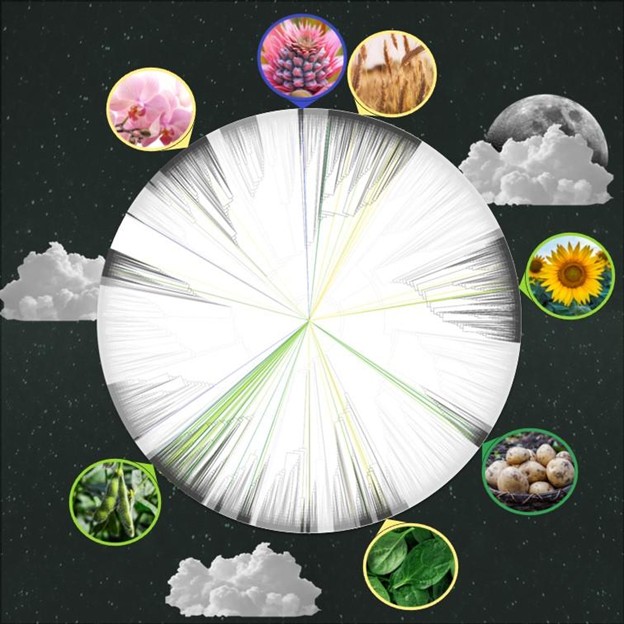
In efforts to better understand how plant photosynthesis is regulated, scientists are studying how Rubisco activity responds to light. In a new meta-analysis study, a team from the Realizing Increased Photosynthetic Efficiency (RIPE) project at Lancaster University have identified a potential link between photosynthetic pathway type and rates of dark inhibition.
Rubisco, the most abundant enzyme on earth, is essential for photosynthesis. It takes carbon dioxide from the atmosphere and creates usable sugar molecules. In many plant species, a nocturnal inhibitor molecule called CA1P builds up in darkness and low light, blocking the activity of Rubisco. In the light, CA1P is broken down and Rubisco activity is restored. This phenomenon is called “dark inhibition”. CA1P levels, and consequently dark inhibition rates, vary widely between plant species, even among closely related ones. Why plants have this on/off switch, and why its prevalence varies so widely across species, has remained poorly understood.
Lancaster University researchers Connor Nehls-Ramos and Assistant Professor Doug Orr set out to explore an evolutionary connection for the wide variation of dark inhibition rates across all flowering plants. A deeper understanding of how and why CA1P regulates Rubisco activity could help inform future efforts to engineer photosynthesis for crops with improved yield and efficiency.
“If we look at this from an evolutionary point of view, we may be able to find certain trends in adaptation across different groups of plants,” said Nehls-Ramos. “We have lots of questions about this nocturnal inhibitor. Why would certain plants carry this trait while others have seemingly no dark inhibition? Is dark inhibition a new thing, or is it a carry-over from a more ancient metabolic process? Are these different inhibition levels indicating something more nuanced in chloroplast regulation?”
To investigate, the team compiled dark inhibition data for 157 flowering plant species across 14 orders, drawing from 45 published sources, making it one of the most comprehensive syntheses of this data to date.
“Compiling data on dark inhibition was no easy task,” said Nehls-Ramos. “There were two main limitations: the methodological differences between studies and the lack of current work using similar methods for comparison. While most studies used similar techniques, variation in methods meant a further layer of complexity and were an additional consideration. Most data we have is also older, being before 2000. Our hope is that our current work may help inspire future work in filling in the gaps.”
While no single evolutionary pattern emerged across the flowering plant family tree, the data revealed differences tied to photosynthetic strategy. Plants doing C3 photosynthesis, used by most plants, directly fix CO2 into sugar molecules and show variable levels of dark inhibition. C4 plants, which spatially separate photosynthetic steps to improve efficiency in hot environments, mostly have little to no dark inhibition. Conversely, CAM plants, which evolved to fix CO2 at night to conserve water in arid climates, were generally found to have elevated levels of dark inhibition.
“The potential for a connection between dark inhibition levels and photosynthetic subtype is quite interesting, and not something we anticipated. These findings suggest future work needs to consider different photosynthetic subtypes as a possible factor in understanding the role of dark inhibition,” said Orr.
The researchers hope the study will encourage others in the field to study dark inhibition rates in a wider range of plant species.
“It's a paper that both points towards some new understanding of this mechanism and also potentially connecting over to more fundamental metabolic mechanisms in the chloroplast”, said Nehls-Ramos. “I think this could be an angle for understanding how chloroplasts and photosynthesis work that we have yet to take full advantage of. It might point to other yet-discovered mechanisms for chloroplast regulation, which could help in developing higher yielding, more efficient plants.”
This work was conducted as part of the RIPE project, an international research collaboration focused on improving how food crops use sunlight. The research was supported by Gates Agricultural Innovations and contributes to RIPE’s Improving Rubisco objective, which seeks to improve Rubisco activity and regulation to increase photosynthetic productivity.
By: Brittany Prempin, RIPE project
Publication information:
Connor Nehls-Ramos, Elizabete Carmo-Silva, Douglas J Orr. (2026) Rubisco Dark Inhibition in Angiosperms Shows a Complex Distribution Pattern, Journal of Experimental Botany, 2026;, erag090,https://doi.org/10.1093/jxb/erag090